Why is this Ebola outbreak so different?
On May 15, 2026, the Democratic Republic of Congo's Ministry of Health officially declared an Ebola disease outbreak in the northeast of the country, where Doctors Without Borders (MSF) teams are operating. Since then, authorities have reported nearly 500 suspected cases and more than 130 deaths across multiple health zones. On the same day, Uganda announced the virus had crossed its borders. The outbreak is caused by the Bundibugyo virus - rarer and one for which no vaccine or treatment has been approved yet. Here is what we know about the unfolding crisis in the DRC and Uganda.

Are there vaccines available to fight this Ebola disease outbreak?
There are currently two approved vaccines against Ebola disease, but neither is approved for use in cases of infection with the Bundibugyo virus.
The Ervebo vaccine (rVSV-ZEBOV) can be used to limit the spread of the disease through a so-called “ring vaccination” strategy, meaning it is administered to people who have been in contact with an infected individual, secondary contacts, and healthcare workers. Another vaccine can be used both during outbreaks for people at risk of exposure to the virus, and as a preventive measure before outbreaks for frontline responders or those living in areas not yet affected by the outbreak.
However, these two vaccines are currently approved only against the most common virus responsible for Ebola disease (known as the “Ebola virus,” formerly called the “Zaire virus”), which notably caused the devastating outbreak in West Africa between 2014 and 2016.
Discussions are underway within the WHO to determine which vaccine candidates could be tested in emergency clinical trials against the Bundibugyo virus, as has been done in previous Ebola disease outbreaks. MSF is ready to contribute to this research, as it did during the trials conducted in the DRC in 2019. Those trials led to the approval and market release of two vaccines and treatments.

Is there a treatment for the Bundibugyo virus?
There is currently no approved treatment for Ebola disease caused by Bundibugyo virus.
The two monoclonal antibodies licensed following clinical trials conducted in the DRC between 2018 and 2020 are likewise specific to one species of Ebola, but not to Bundibugyo virus. That said, antiviral candidates and experimental monoclonal antibodies do exist, though their efficacy has yet to be established.
In the absence of a specific treatment, care relies primarily on symptom management (such as fever, headache, vomiting, diarrhea, etc.) and intensive supportive therapy aimed at improving patients' chances of survival: fluid replacement, oxygen support, and close monitoring of blood and cardiac parameters. During the two previous Ebola disease outbreaks caused by Bundibugyo virus, the estimated case fatality rate ranged between 25 and 40%.
What detection tools are available?
An additional major obstacle in the response to this outbreak is the ability to rapidly diagnose those affected by the disease. PCR tests require virus-specific diagnostic cartridges. However, these cartridges are currently available in insufficient quantities for the Bundibugyo virus, which considerably slows down case confirmation and, as a result, the implementation of contact tracing and patient isolation.

Without any approved vaccine or treatment, what can be done to limit the spread?
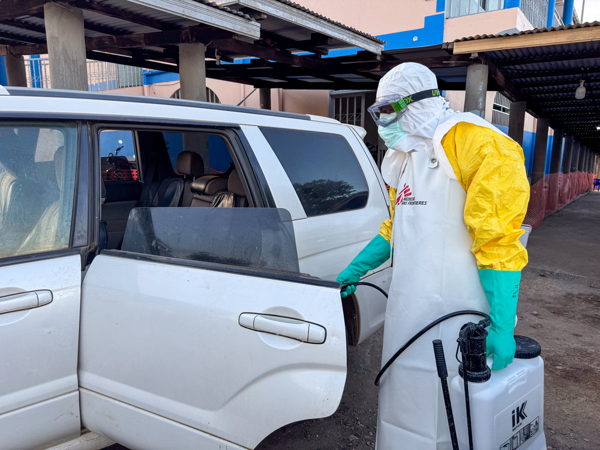
In the absence of approved treatments and vaccines, the response rests on a combination of epidemiological and public health measures: early isolation of suspected and confirmed cases; daily monitoring of contacts over 21 days with immediate quarantine at the onset of symptoms; strict infection prevention and control protocols (hand hygiene, waste management, chlorinated water points, PPE for healthcare workers); safe and dignified burials to prevent transmission during funeral rituals; and on-the-ground epidemiological work to reconstruct transmission chains and identify high-risk practices. It is also critical to ensure continued access to non-Ebola-related care for people in affected areas.
None of this can function without sustained community engagement - informing people and building trust; a far more difficult task in contexts marked by insecurity and limited access to healthcare such as in DRC provinces currently affected by the disease.
The urgency of a swift response is underscored by a sobering figure: more than 50 people had already died since the beginning of April, before the outbreak was even officially declared on May 15 - a sign of delayed detection, a pattern that is characteristic of the early stages of Ebola disease outbreaks, but especially worrying in the current one in light of the high numbers of suspect cases and deaths already announced.

What do we know about the spread of the outbreak?
MSF received the first alerts on May 9 and 10, reporting a growing number of deaths in the Mongwalu health zone, northwest of Bunia, in Ituri. Cases were subsequently identified in the Bunia and Rwampara health zones, and a few days later in the neighboring province of North Kivu, including its capital Goma, pointing to already significant spread across the territory.
Health authorities in Uganda - which shares a border with the DRC - confirmed a first case, who died on May 14. On Sunday, May 17, the World Health Organization (WHO) activated its highest alert level in response to the outbreak.
This is the seventeenth Ebola outbreak the DRC has experienced since the first case was discovered in 1976, and the third to specifically involve the Bundibugyo virus, following outbreaks in Uganda in 2007–2008 and in the DRC in 2012. Over the past decade, MSF has responded to multiple Ebola disease outbreaks, most notably in West Africa between 2014 and 2016, in the DRC between 2018 and 2020, and in Uganda in 2022 and 2025.
 An MSF truck is loaded at Bunia airport with emergency response supplies delivered by cargo flight from MSF Support Unit Kampala (SUKA). The shipment includes 3,000 items of personal protective equipment (PPE) and medical supplies for the Ebola response. Photographer: ANNA SCHÖNHOFER | Date: 19/05/2026 | Location: Democratic Republic of Congo
 View of the entrance to the National Institute of Biomedical Research in Goma. Preventive measures have been put in place before entering this facility where samples from people suspected of having Ebola are tested. Photographer: Daniel Buuma | Date: 19/05/2026 | Location: Democratic Republic of Congo
 View of the courtyard of Mwanga College in Goma. Students wash their hands before entering their classes as part of Ebola disease prevention measures. Photographer: Daniel Buuma | Date: 19/05/2026 | Location: Democratic Republic of Congo
 MSF teams conducted training for staff at Kyeshero Hospital in Goma on how to work in an Ebola environment. Photographer: Maria Elena del Carre | Date: 20/05/2026 | Location: Democratic Republic of Congo
20260520_The Bundibugyo virus challenge _ why is this Ebola disease outbreak different_EN.docx
DOCX 1.6 MB
MSF368648(High)EbolaExplainer.mp4
MP4 252 MB
Rebaone Mogoera
About Doctors Without Borders (MSF)
Doctors Without Borders (MSF) is a global network of principled medical and other professionals who specialise in medical humanitarian work, driven by our common humanity and guided by medical ethics. We strive to bring emergency medical care to people caught in conflicts, crises, and disasters in more than 70 countries worldwide.
In South Africa, we currently run a non-communicable diseases (NCDs) project in Butterworth, Eastern Cape province, where we support the Department of Health (DoH) in improving care for patients with diabetes and hypertension. The project focuses on improving screening, diagnosis, management, and prevention of NCDs through advocacy, research, health promotion, training, and mentorship of Community Healthcare Workers.
MSF is also recognised as one of the pioneers in providing antiretroviral treatment (ART) in the public sector. It started the first HIV programme in South Africa in 1999. The organisation's earlier interventions in the country have primarily been on developing new testing and treatment strategies for HIV/AIDS and Tuberculosis (TB) in Eshowe (Kwa-Zulu Natal) and Khayelitsha (Western Cape). The Eshowe project was handed over to DoH in 2023 after 12 years of operations. The Khayelitsha project was closed in 2020 after 22 years of activities and campaigning for improved HIV and TB treatment.
Other projects we have been involved in include our Migrant Project in the country's capital, Tshwane, which was handed over to authorities and a local Community-Based Organisation after building the capacity to work with undocumented populations. We also previously offered free, high-quality, and confidential medical care to survivors of sexual and gender-based violence in Rustenburg, North West province.
To learn more about our work in South Africa, please visit this page on our website (www.msf.org.za). To support MSF’s work:
- SMS “JOIN” to 42110 to donate R30 Once-off
- Visit https://www.msf.org.za/donate