MSF wants to buy groundbreaking HIV prevention drug. Why won’t Gilead sell?
Today, Doctors Without Borders (MSF) sent an open letter to the US pharmaceutical corporation Gilead Sciences, calling on the company to immediately sell to MSF, lenacapavir, an HIV medicine that is one of the most important advances in HIV prevention in decades.
About 1.3 million people worldwide acquire HIV every year, underscoring the urgent need to scale up access to highly effective prevention tools such as long-action pre-exposure prophylaxis (PrEP) medications. MSF, an international medical humanitarian organisation, focuses HIV prevention activities on key vulnerable populations like men who have sex with men, transgender individuals, and sex workers, and works in conflict and other fragile settings. Access to HIV prevention medicines, and maintaining adherence to taking daily doses, can be extremely difficult. Long-acting HIV prevention tools like lenacapavir, which only needs to be given twice a year by injection, can thus be life-saving for people at high HIV risk.

Despite Gilead’s public claims that it can expand production of lenacapavir to meet needs, the company has refused requests from MSF to purchase a limited supply for use in our programmes. So far, only a handful of countries of the 18 eligible under the Gilead and Global Fund agreement, have received doses of lenacapavir, while millions of people remain at high risk of HIV acquisition worldwide.
Gilead has directed MSF to source doses through the Global Fund, even though their supply is fixed and insufficient – enough for up to 2 million people over 3 years, which is well below the global need. Furthermore, some countries where MSF works are not eligible to receive doses through the Global Fund due to restrictions put in place by Gilead.
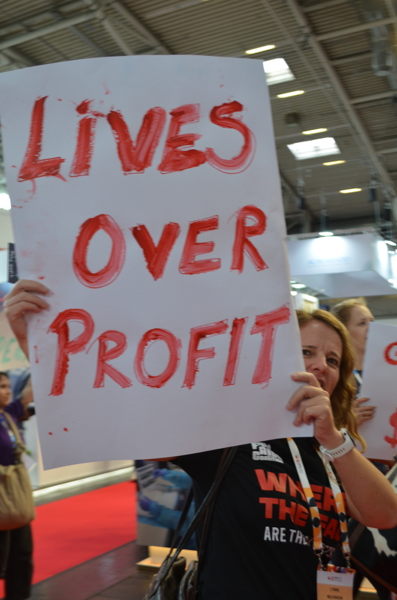
“Blocking humanitarian organisations from accessing a medical breakthrough puts vulnerable people in danger,” Dr Tom Ellman, Director of the Southern Africa Medical Unit (SAMU), MSF, said. “Gilead must decide whether it prioritises protecting people or protecting control and profit. This is a chilling echo of the policies we saw in the 1990s when antiretrovirals were provided to those in the global North, while the rest of the world was denied access and many lives were lost to HIV/AIDS.”
MSF has requested an urgent follow-up meeting with Gilead by 13 April to clarify if they will sell lenacapavir directly, at what price it will be sold, and when supply can begin.
Open Letter
FINAL Press Release Gilead Letter.docx
DOCX 27 KB
Rebaone Mogoera
About Doctors Without Borders (MSF)
Doctors Without Borders (MSF) is a global network of principled medical and other professionals who specialise in medical humanitarian work, driven by our common humanity and guided by medical ethics. We strive to bring emergency medical care to people caught in conflicts, crises, and disasters in more than 70 countries worldwide.
In South Africa, we currently run a non-communicable diseases (NCDs) project in Butterworth, Eastern Cape province, where we support the Department of Health (DoH) in improving care for patients with diabetes and hypertension. The project focuses on improving screening, diagnosis, management, and prevention of NCDs through advocacy, research, health promotion, training, and mentorship of Community Healthcare Workers.
MSF is also recognised as one of the pioneers in providing antiretroviral treatment (ART) in the public sector. It started the first HIV programme in South Africa in 1999. The organisation's earlier interventions in the country have primarily been on developing new testing and treatment strategies for HIV/AIDS and Tuberculosis (TB) in Eshowe (Kwa-Zulu Natal) and Khayelitsha (Western Cape). The Eshowe project was handed over to DoH in 2023 after 12 years of operations. The Khayelitsha project was closed in 2020 after 22 years of activities and campaigning for improved HIV and TB treatment.
Other projects we have been involved in include our Migrant Project in the country's capital, Tshwane, which was handed over to authorities and a local Community-Based Organisation after building the capacity to work with undocumented populations. We also previously offered free, high-quality, and confidential medical care to survivors of sexual and gender-based violence in Rustenburg, North West province.
To learn more about our work in South Africa, please visit this page on our website (www.msf.org.za). To support MSF’s work:
- SMS “JOIN” to 42110 to donate R30 Once-off
- Visit https://www.msf.org.za/donate