LEBANON: Death toll tops 1,000, children paying the price
Four weeks into the latest escalation in Lebanon, Israel's ongoing bombardment and the subsequent forced displacement of people are severely impacting people's lives and their access to essential services, warns Doctors Without Borders (MSF). MSF calls for the protection of civilians and healthcare, and for an end to measures that force people indefinitely from their homes.
Since 2 March, civilians have faced increasingly dire conditions, as a marked escalation of attacks by Israeli forces has forced more than one million people from their homes and disrupted their access to healthcare. According to the Ministry of Health, 1,039 people have been killed, 12 per cent of whom are children, between 2 and 23 March.
Combined with ground attacks and repetitive airstrikes targeting civilian infrastructure such as bridges in the south of Lebanon, these actions are effectively isolating large cities and numerous villages south of the Litani River, along with their remaining residents, from the rest of the country.
"We are worried about the safety of the civilians who did not leave these areas, whether by choice or by lack of means," said Dr Tejshri Shah, MSF General Director, visiting Lebanon.
"We call for the protection of civilians and medical structures at all times, allowing people to continue to access healthcare and other essential services."

Evacuation orders collectively covering 14 per cent of Lebanon’s area has resulted in the displacement of one of five people in Lebanon. Even in places outside the marked ‘evacuation’ zones, including parts of Beirut and the southern parts of the country, people live under the immediate threats of recurrent air and drone strikes.
Despite forced displacement orders, many people have chosen to stay, rather than abandon their homes and villages, while others have had no choice due to socio-economic and medical vulnerabilities. This has made it extremely difficult for them to access medical care, and similarly difficult for medical and humanitarian workers to reach them.
“Hospital staff in Nabatiyeh, who decided to continue working there, have no choice but to shelter inside the hospital, avoiding car travels, and in search for safety," said Dr Luna Hammad, MSF medical coordinator who visited the Nabatiyeh Governmental Hospital, one of the hospitals receiving the most casualties in Lebanon today.
“They have been enduring this for weeks, with very little rest, carrying the weight of constant pressure and fear while hospitals continue to receive mass casualty events."
Several hospitals in southern Lebanon remain functional and are providing initial emergency care and referrals. MSF is supporting these facilities with medical supplies, fuel for electricity, and essential relief items such as blankets and hygiene kits.

According to the World Health Organization (WHO), as of 23 March, more than 63 attacks on healthcare facilities have been reported, with 40 healthcare workers killed and another 91 injured. In addition, more than five hospitals have been forced to evacuate, and more than 54 primary health care centres across Lebanon have had to close, further limiting access to essential health services.
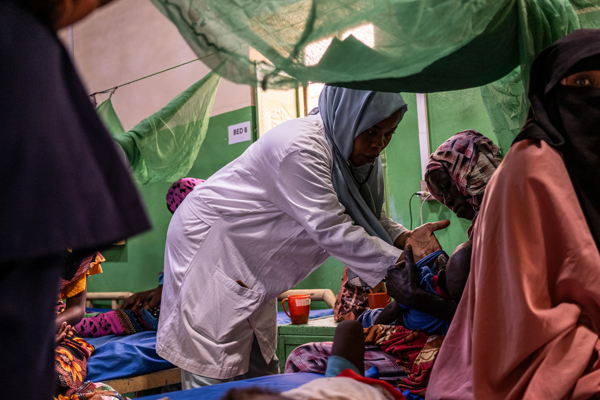
A displaced 56-year-old leukaemia patient who visited one of MSF’s mobile clinics described the impact of disrupted care after hospitals were evacuated: “I fled with nothing and I have nowhere to go. I had hopes I almost beat cancer. Now, I spend nights in a tent in a park, and I don’t know where I’ll find my next dose of medication or how I’ll continue my treatment.”
In parts of Beirut, Mount Lebanon, South Lebanon, North Lebanon and Akkar, MSF teams are providing primary healthcare, referrals and support to help people continue treatment, but sustained access to specialised and chronic care remains disrupted.
As bombardment and displacement continue, the space for people to survive and for health services to function is shrinking day by day. MSF calls for the protection of civilians and healthcare, and for an end to measures that force people indefinitely from their homes and cut them off from treatment.
Additional information:
On 2 March, MSF launched a nationwide emergency response in Lebanon to support affected communities through 15 mobile clinics as well as mobile mental health teams. MSF is also supporting hospitals in impacted areas by donating medical supplies, providing fuel, and distributing food parcels to staff.
Many people have been forced to leave under threat of fire, leaving behind most of their belongings, and are now living in overcrowded collective shelters or temporary sites with limited privacy and basic services. MSF has therefore scaled up both medical and humanitarian assistance. Since 2 March, MSF teams have provided more than 6,826 medical consultations, including over 1,298 sexual and reproductive health consultations. To date, MSF has distributed more than 10,853 blankets and 9,315 mattresses to help ease harsh living conditions.
As part of a water, sanitation and hygiene intervention, MSF has distributed more than 7,879 hygiene kits and helped improve access to safe drinking water by distributing 223,942 litres, in addition to water trucking more than 7,196,000 litres to multiple shelters. MSF teams have also rehabilitated toilets and sewage systems in some shelter sites, to reduce health risks linked to overcrowding and deteriorating water and sanitation services.
Simultaneously, MSF has launched a mental health helpline to provide free, remote and confidential support to people overwhelmed by the current situation, offering a safe space to speak with MSF psychologists and access psychological first aid and guidance on available services.
 We have already delivered 7,000 blankets, 4,000 mattresses, 5,820 hygiene kits, as well as 2,015 floor mats and other necessities to support the war-affected communities as they rebuild their lives. Photographer: Maryam Srour | Date: 23/01/2025 | Location: Lebanon
 Residential buildings destroyed in the densely populated Dahye neighborhood in southern Beirut. Photographer: Maryam Srour | Date: 14/03/2026 | Location: Lebanon
202603_Lebanon_Briefing Note_En.pdf
PDF 1.5 MB
202603_Lebanon_PR_Impacts on civilians_En.docx
DOCX 33 KB
Jane Rabothata
Palesa Ledimo
About Doctors Without Borders (MSF)
Doctors Without Borders (MSF) is a global network of principled medical and other professionals who specialise in medical humanitarian work, driven by our common humanity and guided by medical ethics. We strive to bring emergency medical care to people caught in conflicts, crises, and disasters in more than 70 countries worldwide.
In South Africa, we currently run a non-communicable diseases (NCDs) project in Butterworth, Eastern Cape province, where we support the Department of Health (DoH) in improving care for patients with diabetes and hypertension. The project focuses on improving screening, diagnosis, management, and prevention of NCDs through advocacy, research, health promotion, training, and mentorship of Community Healthcare Workers.
MSF is also recognised as one of the pioneers in providing antiretroviral treatment (ART) in the public sector. It started the first HIV programme in South Africa in 1999. The organisation's earlier interventions in the country have primarily been on developing new testing and treatment strategies for HIV/AIDS and Tuberculosis (TB) in Eshowe (Kwa-Zulu Natal) and Khayelitsha (Western Cape). The Eshowe project was handed over to DoH in 2023 after 12 years of operations. The Khayelitsha project was closed in 2020 after 22 years of activities and campaigning for improved HIV and TB treatment.
Other projects we have been involved in include our Migrant Project in the country's capital, Tshwane, which was handed over to authorities and a local Community-Based Organisation after building the capacity to work with undocumented populations. We also previously offered free, high-quality, and confidential medical care to survivors of sexual and gender-based violence in Rustenburg, North West province.
To learn more about our work in South Africa, please visit this page on our website (www.msf.org.za). To support MSF’s work:
- SMS “JOIN” to 42110 to donate R30 Once-off
- Visit https://www.msf.org.za/donate