ZIMBABWE: Serious barriers prevents adolescents from accessing SRH services safely & confidentially
In Zimbabwe, a host of barriers are preventing adolescents, defined as aged 10 to 19 years, from accessing sexual and reproductive health (SRH) services safely and confidentially without the consent of their parents.
Without free and informative access to health services that include contraceptives, treatment for sexually transmitted infections and condoms, national studies show that rates of adolescent pregnancy and HIV are increasing, while knowledge levels around sexual health are declining. One study revealed that Zimbabwe has the highest teenage fertility rate in sub-Saharan Africa with one in every 10 girls aged between 15 and 19 years falling pregnant every year.
Culturally, young people are often expected to abstain from sex until they get married. National law states that young people below the age of 16 years can’t take an HIV test without parental consent, and health workers often stigmatize young people seeking sexual health advice.
Yet in many communities like Mbare, a sprawling high-density suburb in the capital Harare, the reality is that young people start having sex and experimenting as early as 12 years, frequently without protection or information on how to prevent unwanted pregnancies, STIs and HIV infection.
Young people living with HIV also face particular difficulties, especially if they only learn of their HIV status by accident in their teens. Most find it difficult to accept their condition, and often stop taking their antiretroviral treatment (ART). Crowded living conditions which force young people out of their homes and abuse of alcohol and drugs also plays havoc with staying on regular treatment.
Recognizing the huge vulnerability of adolescents without access to free sexual and reproductive health services, MSF partnered with the Harare City health department to start an ‘adolescent-friendly corner’ at Edith Opperman clinic in Mbare. Staff in the brightly coloured rooms offer free services which include general health check-ups, HIV testing and counselling, screening for sexually transmitted infections (STIs) and contraceptive services.
In between appointments, young visitors can play pool or chat with ‘peer educators’, themselves young people, who MSF has trained and mentored to discuss sexual health issues with their peers or encourage them to stick to their treatment.
In 2017, 2454 consultations were provided for young people in the ‘adolescent corner.
.jpg)
.jpg)
.jpg)
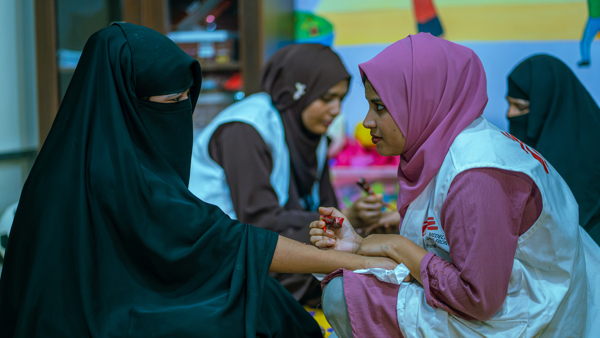
.jpg) A nurse pricks a patient's finger during an HIV test. Photographer: Charmaine Chitate
A nurse pricks a patient's finger during an HIV test. Photographer: Charmaine Chitate.jpg) A peer educator at the Mbare Polyclinic Adolescent Corner describes the nature of their activities to the waiting line. Photographer: Charmaine Chitate
A peer educator at the Mbare Polyclinic Adolescent Corner describes the nature of their activities to the waiting line. Photographer: Charmaine Chitate.jpg) A peer educator shares his opinion in a group meeting. Photographer: Charmaine Chitate
A peer educator shares his opinion in a group meeting. Photographer: Charmaine Chitate.jpg) A peer educators group meeting in Mbare. Photographer: Charmaine Chitate
A peer educators group meeting in Mbare. Photographer: Charmaine Chitate.jpg) Adolescents relaxing in the ‘adolescent friendly corner’ at the Edith Opperman clinic in Mbare, Harare.
MSF, alongside the City of Harare Health Department, has run an adolescent-friendly corner at the Edith Opperman clinic in Mbare, Harare, since November 2015. MSF provides adolescent- friendly services that include general health check-ups, HIV testing and counselling, screening for sexually transmitted infections (STIs), and family planning, all free of charge. Photographer: Charmaine Chitate
Adolescents relaxing in the ‘adolescent friendly corner’ at the Edith Opperman clinic in Mbare, Harare.
MSF, alongside the City of Harare Health Department, has run an adolescent-friendly corner at the Edith Opperman clinic in Mbare, Harare, since November 2015. MSF provides adolescent- friendly services that include general health check-ups, HIV testing and counselling, screening for sexually transmitted infections (STIs), and family planning, all free of charge. Photographer: Charmaine Chitate.jpg) An an 18 year-old woman receives the results of her HIV test. Photographer: Charmaine Chitate
An an 18 year-old woman receives the results of her HIV test. Photographer: Charmaine Chitate.jpg) Mbare Polyclinic Adolescent corner creates a conducive environment to initiate conversations regarding sexual and reproductive health. Photographer: Charmaine Chitate
Mbare Polyclinic Adolescent corner creates a conducive environment to initiate conversations regarding sexual and reproductive health. Photographer: Charmaine Chitate.jpg) Rutendo, MSF peer educator in MSF’s ‘adolescent friendly corner’ at the Edith Opperman clinic in Mbare, Harare.
“I feel happy that I am now a peer educator and I educate people using my own experience.” Photographer: Charmaine Chitate
Rutendo, MSF peer educator in MSF’s ‘adolescent friendly corner’ at the Edith Opperman clinic in Mbare, Harare.
“I feel happy that I am now a peer educator and I educate people using my own experience.” Photographer: Charmaine Chitate.jpg)
.jpg)
.jpg) Tapiwa stands on the scale as her weight needs to be documented with her Medical affidavit. Photographer: Charmaine Chitate
Tapiwa stands on the scale as her weight needs to be documented with her Medical affidavit. Photographer: Charmaine Chitate.jpg) Tapiwa, MSF peer educator in MSF’s ‘adolescent friendly corner’ at the Edith Opperman clinic in Mbare, Harare.
“Many adolescents suffer in silence.”
MSF, alongside the City of Harare Health Department, has run an adolescent-friendly corner at the Edith Opperman clinic in Mbare, Harare, since November 2015. MSF provides adolescent- friendly services that include general health check-ups, HIV testing and counselling, screening for sexually transmitted infections (STIs), and family planning, all free of charge. Photographer: Charmaine Chitate
Tapiwa, MSF peer educator in MSF’s ‘adolescent friendly corner’ at the Edith Opperman clinic in Mbare, Harare.
“Many adolescents suffer in silence.”
MSF, alongside the City of Harare Health Department, has run an adolescent-friendly corner at the Edith Opperman clinic in Mbare, Harare, since November 2015. MSF provides adolescent- friendly services that include general health check-ups, HIV testing and counselling, screening for sexually transmitted infections (STIs), and family planning, all free of charge. Photographer: Charmaine Chitate