Yemen: Cholera outbreak threatens to get out of control
Yemen
As cases of cholera and acute watery diarrhea rise across Yemen, international medical organisation Doctors Without Borders (MSF) warns that the outbreak is threatening to get out of control and calls for an urgent and appropriate response.
The number of suspected cases has more than doubled in the past five days, from 11,000 on 14 May to more than 23,500 on 19 May, according to World Health Organization figures. The disease has now spread across 18 of Yemen’s 22 governorates, according to Yemen’s Ministry of Public Health and Population.
MSF teams have treated 3,092 patients in 4 cholera treatment centres and 9 cholera treatment units in the governorates of Amran, Houdaydah, Hajja, Al Dhale, Taiz and Ibb. They are expecting a delivery of more than 63 tons of supplies to arrive in Yemen in the coming days.
“The fast spread of the current outbreak is extremely alarming,” says Ghassan Abou Chaar, MSF’s head of mission in Yemen. “Before the outbreak, the health system was already overstretched and people’s health needs were already huge. To bring the outbreak under control, it won’t be enough simply to treat those people who reach medical facilities. We also need to address the source of the disease, by improving water and sanitation and working in communities to prevent new cases.”
The war in Yemen, which escalated in March 2015, has had a serious impact on the country’s already weak health system. Many health facilities no longer function, and there are shortages of medications, including intravenous fluids and oral rehydration salts, both essential for the treatment of cholera.
Efforts to treat patients are also hampered by staff shortages. Medical staff in Yemen have received no salaries since September 2016, and many have been obliged to find other types of work to support their families. Meanwhile, insecurity hampers the ability of aid organisations to reach some of the affected areas.
MSF calls for imports of medical supplies into Yemen to be facilitated, and for Yemeni medical staff to be paid incentives so that they can carry out their work. MSF also calls on all parties to the conflict to ensure that medical and humanitarian workers are able to reach the affected areas in order to run medical facilities, treat patients and bring the outbreak under control.
MSF is an international medical humanitarian organisation working in nearly 70 countries in the world, including Yemen. In Yemen, MSF teams are directly providing healthcare to patients in 13 hospitals and supporting more than 25 hospitals in 11 Yemeni governorates.


 MSF cleaner while spreading chlorination on a bed that has been just emptied after a patient was referred to the inpatient department at MSF cholera treatment center in Khamer. Chlorination of beds is one of the precautions taken to stop the spread of cholera. Photographer: Nuha Haider/MSF
 MSF logistic team in front of MSF cholera treatment center in Khamer. The team has set up four tents for the center to be able to deal with the increased number of patients with cholera in Yemen. MSF is receiving an increased number of cholera patients in Yemen since the beginning of May 2017. This cholera treatment center alone, treated more than 1200 patients in less than two weeks. The center is still receiving an increased number of patients. Photographer: Malak Shaher/MSF

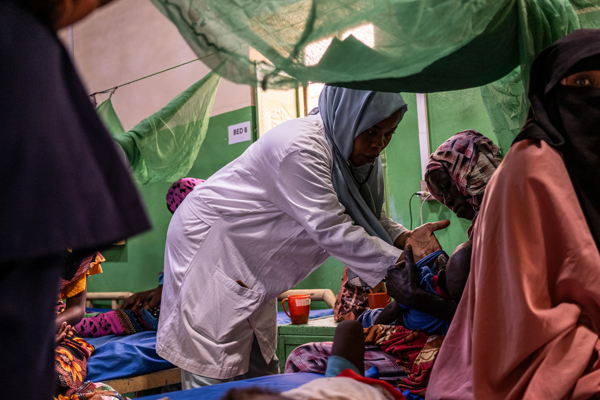
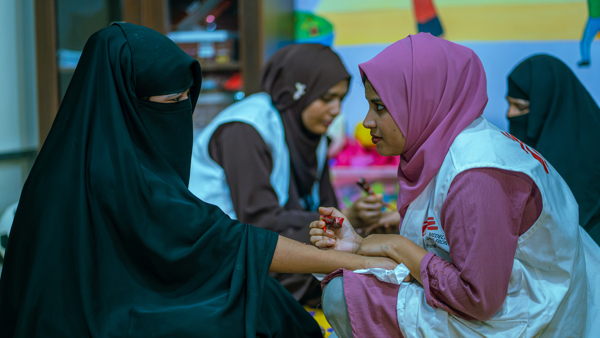
 MSF nurse with a women while checking her blood pressure. MSF is receiving an increased number of cholera patients in Yemen since the beginning of May 2017. This cholera treatment center alone, treated more than 1200 patients in less than two weeks. The center is still receiving patients. Photographer: Nuha Haider/MSF
 MSF project coordinator Claire Manera in front of MSF cholera treatment center in Khamer town, Amran. MSF is receiving an increased number of cholera patients in Yemen since the beginning of May 2017. This cholera treatment center alone, treated more than 1200 patients in less than two weeks. The center is still receiving an increased number of patients. Photographer: Malak Shaher/MSF